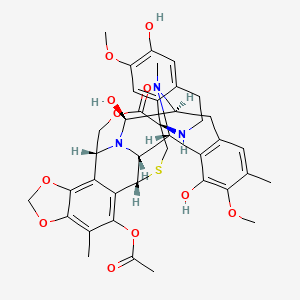
GC18044
Trabectedin
Also known as [(1R,2R,3R,11S,12S,14R,26R)-5,6',12-trihydroxy-6,7'-dimethoxy-7,21,30-trimethyl-27-oxospiro[17,19,28-trioxa-24-thia-13,30-diazaheptacyclo[12.9.6.13,11.02,13.04,9.015,23.016,20]triaconta-4(9),5,7,15,20,22-hexaene-26,1'-3,4-dihydro-2H-isoquinoline]-22-yl] acetate
Trabectedin is a tetrahydroisoquinoline alkaloid with potent antitumor activity· Trabectedin can selectively inhibit transcription factors associated with DNA damage repair and block the DNA nucleotide excision repair pathway, leading to DNA double-strand breaks and tumor cell apoptosis· Trabectedin can also regulate the tumor microenvironment and indirectly exert antitumor effects by inhibiting the activity of tumor-associated macrophages· Trabectedin is often used in the study of soft tissue sarcoma and ovarian cancer
- CAS number
- 114899-77-3
- Molecular weight
- 761.84
- Formula
- C39H43N3O11S
- Solubility
- DMSO : 33·33 mg/mL (43·75 mM; Need ultrasonic)
- InChIKey
- PKVRCIRHQMSYJX-AIFWHQITSA-N
- Catalogue number
- GC18044
- Brand
- GLPBIO
Computed properties PubChem CID 108150 · XLogP 3.4 · TPSA 194 Ų · H-bond donors 4
- XLogP
- 3.4
- TPSA
- 194 Ų
- H-bond donors
- 4
- H-bond acceptors
- 15
- Rotatable bonds
- 4
- Heavy atoms
- 54
SMILES CC1=CC2=C([C@@H]3[C@@H]4[C@H]5C6=C(C(=C7C(=C6[C@@H](N4[C@H]([C@H](C2)N3C)O)COC(=O)[C@@]8(CS5)C9=CC(=C(C=C9CCN8)O)OC)OCO7)C)OC(=O)C)C(=C1OC)O
Computed descriptors from PubChem (CID 108150), public domain. Identity cross-checked against the supplier's molecular formula and weight — verify before use.
Ordering in Israel
- Lead time
- Ships from the manufacturer to your lab in 8–14 business days; customs and cold chain handled by LABO Scientific.
- Pricing
- Quoted in ILS, excl. VAT. Add the item to your quote and we confirm the final price, usually the same business day.
- Documents
- Lot certificate of analysis and manufacturer SDS are emailed with your order confirmation.
- Who we serve
- Universities, hospitals and biotech companies across Israel. Research use only — not for diagnostic or therapeutic use.
- Questions
- WhatsApp · +972-55-990-7576 · orders@labo.co.il